Wednesday, September 16, 2009

DUROOD-E-QURAANI

ALLAHUMMA SALLI WASALLIM ALA SAYYIDINA MUHAMMADIW WA ALA AALI WA ASHABI BI ADADA MA FI JAMI’IL QURAANI HARFAN HARFAN WABI ADADI KULLI HARFIN ALFAN ALFAN.

“O Allah! Send your blessings and peace on Muhammad, our Master, and on his Progeny and his Companions according to the number of every letter in Quran and let each letter carry thousands of blessings and salutations in it”.

This Durood Shareef is a very sacred one. If it is recited after every prayer, it is said that the reciter will receive the Sawaab equivalent to the recital of the entire Holy Quran. After reading the verses of the Holy Quran, this Durood Shareef should be recited 3 times.

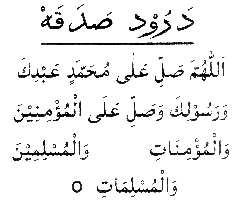
DUROOD-E-SADAQAH

ALLAHUMMA SALLI ALA MUHAMMADIN ABDIKA WA RASOOLIKA WA SALLI ALAL MU’MINEENA WAL MU’MINAATI WAL MUSLIMEENA WAL MUSLIMAATI.

“O Allah! Shower Thy blessings and beneficence on Muhammad, Thy creature and Thy Messenger, and shower beneficence on all men of faith and women of faith, and Muslim men and Muslim women”.

This Durood Shareef is a special one. Hadrat Abu Saeed Khudri (radi Allahu anhu), a close companion of the Holy Prophet (sallal laahu alaihi wasallam), says that Sayyiduna Rasoolullah (sallal laahu alaihi wasallam) said: “Whoever does not possess wealth to give in charity, should recite this Durood in his Du’a. It will become a source of (spiritual) cleanliness for him”.Hadrat Abu Huraira (radi Allahu anhu) says that the Holy Prophet (sallal laahu alaihi wasallam) said: “Allah has said, ‘If you spend I shall spend on you’”. This means that if you spend your money on others – the poor, sick, needy and the orphan – Allah will give you in abundance. But, what if a man has nothing to give in charity? By reading Durood-e-Sadaqah, it will suffice.

DUROOD-E-WALI


ALLAHUMMA SALLI ALA MUHAMMADININ NABI YIL UMMI YI WA AALIHI WABAARIK WA SALLIM.

“O Allah! Send blessings on Muhammad, our chief the unlettered Apostle and his Family Thy favours and thy Salutations”.

Hadrat Shah Wali’ullah Dehlvi (radi Allahu anhu) said that his father commanded him to recite the above Durood Shareef as it was the best one.

Hadrat Abu Hurairah (radi Allahu anhu), a close companion of Sayyiduna Rasoolullah (sallal laahu alaihi wasallam), has said that if a person recites this Durood eighty times on Friday (after evening prayers), then his sins equivalent to 80 years will be forgiven.

This is a very important Durood Shareef which brings forth immediate success and satisfaction to the heart and the mind.

Hadrat Zarar bin Auzar (radi Allahu anhu), another companion of the Holy Prophet (sallal laahu alaihi wasallam) says that he used to recite this Durood Shareef and fight with the non-believers. In every battle, he saw that success kissed his feet, and he never lost any battle on any day.

DUROOD-E-ALI

ALLHUMMAJ AL SALAWAATIKA WA BARAKAATIKA ALA MUHAMMADININ NABI YI WA AZWAAJIHI UMMAHAATIL MU’MINEENA WAZURRIYATIHI WA AHLI BAYTIHI KAMA SALLAYTA ALA IBRAHIMA INNAKA HAMEEDUM MAJEED.

“O Allah! Bestow blessing and bounty on our Prophet and on his wives, who are the Mothers of the Faithful, and on his descendants and on the members of his Household in the manner as Thou conferred blessings on Prophet Ibrahim. Verily, thou art the Praiseworthy and the Glorious”.

Hadrat Ali (radi Allahu anhu) said that if any one wishes that he should get the maximum reward for one Durood alone, then he must recite the above Durood Shareef.

Salawat/Durood Nariya

Salawat/Durood Nariya

اَللّٰهُمَّ صَلِّ صَلٰوةً کَامِلَةً وَّ سَلِّمْ سَلَامًا تَامًّا عَلٰی سَیِّدِنَا مُحَمَّدِ نِ الَّذِیْ تَنْحَلُّ بِهِ الْعُقَدُ وَ تَنْفَرِجُ بِهِ الْکُرَبُ وَ تُقْضٰی بِهِ الْحَوَآئِجُ وَ تُنَالُ بِهِ الرَّغَآئِبُ وَ حُسْنُ الْخَوَاتِمِ وَ یُسْتَسْقَی الْغَمَامُ بِوَجْهِهِ الْکَرِیْمِ وَ عَلٰۤی اٰلِهٖ وَ صَحْبِهٖ فِیْ کُلِّ لَمْحَةٍ وَّ نَفَسٍۭ بِعَدَدِ کُلِّ مَعْلُوْمٍ لَّکَ یَا اللّٰه یَا اللّٰه یَا اللّٰه

Transliteration:
Allah-humma sale salawaatan kaamilatan wa sallim salaaman Taa-aman ala'a sayyedinaa Muhammad allazi tanhalo behi al-aqad wa tanfirjo behil kurabo wa tuqzaa behil hawaa ijo wa tunaalo behi al-raqhaaibo wa Husnu-ul-khawa-time wa yus-tas qayel. Ghamaa-mo-be-wajhe-hi al-karime wa ala'a aalehi wa sahbehi Fii kulle Lamhatin wa nafsin baa-dada kulle Maloomin laka yaa Allah yaa Allah yaa Allah.

Translation:
Oh Allah, every moment and every breath, bestow complete and the best blessings and perfect peace, which is endless on Muhammad (صَلَّى اللهُ عَلَيْهِ وَاٰلِهٖ وَسَلَّم) our Master and his posterity, and his companions; and may for his sake all our troubles and tortures be over. [May all our] calamities end and all our needs fulfilled, all our cherished desires attained, and good ends vouchsafed and clouds are laden with water through the glorious countenance of the Prophet (صَلَّى اللهُ عَلَيْهِ وَاٰلِهٖ وَسَلَّم).

Salawat / Durood Nariya: An Explanation

What Is Durood Nariya?

Durood Nariya, also known as Durood Tafreej or Salat-ut-Tafreejiyyah, is one of the most widely recited forms of Salawat (blessings) upon the Prophet Muhammad (peace be upon him) in the Muslim world. It is especially popular in South Asia, North Africa, and among Sufi communities, where it is recited individually and in congregational gatherings for the fulfillment of needs, relief from hardship, and spiritual blessing.

The name "Nariya" is generally understood to relate to the concept of relief from "naar" (fire/distress) or difficulty, while "Tafreej" directly means "relief" or "opening up" of hardship — reflecting the core purpose for which this Durood is recited.

Structure of the Text

Arabic Text

The Durood is a single, flowing supplication addressed to Allah, asking for complete and perfect blessings (Salawat) and peace (Salaam) upon Prophet Muhammad (peace be upon him). It is composed as one continuous sentence, without breaks, which is itself considered part of its unique character.

Transliteration

The Latin transliteration provided renders the Arabic phonetically for those who cannot read Arabic script, allowing them to recite it correctly by sound: "Allahumma salli salawatan kamilatan wa sallim salaman tamman ala sayyidina Muhammad..."

English Translation

The translation captures the meaning: a request for complete blessings and perfect peace upon Prophet Muhammad, through whom knots (difficulties) are untied, grief is relieved, needs are fulfilled, desires are attained, good endings are secured, and rain (mercy) is sought — all through his noble countenance, along with his family and companions, repeated for every moment and breath, as many times as Allah's knowledge encompasses.

Key Themes Within the Supplication

  1. Complete and Perfect Blessings — The prayer opens by asking for Salawat that is "kamilatan" (complete) and Salaam that is "tamman" (perfect/whole), emphasizing totality rather than partial blessing.
  2. Relief from Hardship — The phrase "tanhallu bihi al-uqad" (through whom knots are untied) and "tanfariju bihi al-kurab" (through whom distress is relieved) form the heart of why this Durood is recited during times of difficulty.
  3. Fulfillment of Needs — "Tuqda bihi al-hawa'ij" refers to the fulfillment of needs and requirements, making this a supplication often used when seeking help with personal matters.
  4. Attainment of Desires and Good Endings — The text asks for "husn al-khawatim," meaning a good conclusion to one's life and affairs, alongside the attainment of noble aspirations ("al-ragha'ib").
  5. Mercy Likened to Rain — The phrase about clouds being "laden with water" through the Prophet's noble countenance uses rain as a metaphor for abundant mercy descending upon the supplicant.
  6. Inclusion of Family and Companions — The Durood concludes by extending blessings to the Prophet's family ("aalihi") and companions ("sahbihi"), following the traditional pattern found in most forms of Salawat.
  7. Perpetual Repetition — The closing phrase, repeated for "every moment and breath... as many times as encompassed by Your knowledge," expresses a desire for the blessings to be sent continuously and without limit.

Common Practices Associated with Durood Nariya

  • Individual Recitation: Many people recite it a fixed number of times (commonly 11, 41, 100, or more) daily or during times of difficulty.
  • Congregational Recitation: In some communities, groups gather to recite it collectively a large number of times (sometimes thousands), particularly during hardship, illness, or before undertaking important tasks.
  • Recitation During Distress: It is popularly recited when facing financial trouble, illness, delays in matters, or when seeking a solution to a persistent problem.
  • Recitation for Blessings on Special Occasions: Some also recite it during the month of Rabi-ul-Awwal or on Fridays, alongside other forms of Salawat.

A Note on Authenticity and Scholarly Views

It is worth noting that scholars differ on the origin and authenticity of Durood Nariya. Unlike Quranic verses or verified Hadith texts, this specific wording is a later devotional composition rather than a direct statement of the Prophet (peace be upon him). Some scholars accept its use as a permissible and beneficial form of Salawat given that sending blessings upon the Prophet is itself a recommended act, while others advise caution regarding specific numerical claims of guaranteed outcomes sometimes attributed to it in popular tradition. As with many devotional texts, individuals are generally encouraged to consult local scholars regarding its status and appropriate usage.

Summary

Durood Nariya is a devotional supplication combining praise of the Prophet Muhammad (peace be upon him) with a plea for relief, fulfillment of needs, and abundant mercy. Its poetic structure, rhythmic repetition, and comprehensive scope — covering worldly relief, spiritual attainment, and a good ending to life — explain its widespread popularity across generations of Muslims seeking comfort and blessing through invoking peace upon the Prophet.


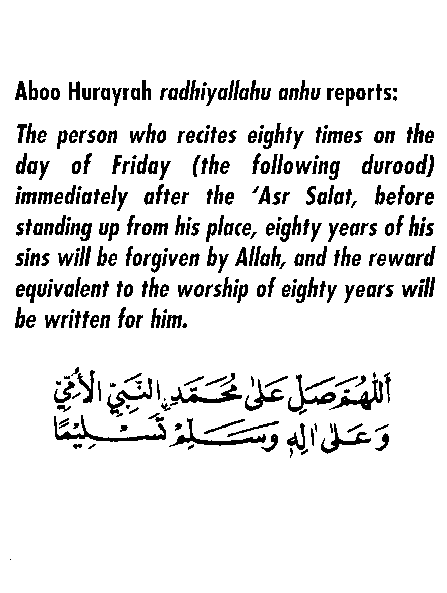
Durood 80 times on Friday after Asr

The Text of the Durood

Arabic Text

اَللّٰهُمَّ صَلِّ عَلٰی مُحَمَّدِ نِ النَّبِیِّ الْاُمِّیِّ وَ عَلٰی اٰلِهٖ وَ سَلِّمْ تَسْلِیْمًا

Transliteration

Allahumma Salle 'Alaa Muhammadinin Nabiyyil Ummiyyi wa-'Alaa Aalehi wa-sallim Tasleeyma.

Translation

"O Allah, bestow Your blessings upon the unlettered Prophet and upon his family; and bestow Your peace upon him and his family."

Aboo Hurayrah radhiyallahu anhu reports:

The person who recites eighty times on the day of Friday (the following durood) immediately after the 'Asr Salat, before standing up from his place, eighty years of his sins will be forgiven by Allah, and the reward equivalent to the worship of eighty years will be written for him.

درودِ پاک کی فضیلت

اَربعینِ عطار، قسط: 2، صفحہ: 35، حدیثِ پاک نمبر 35 ہے:

فرمانِ مصطفٰے صَلَّی اللہُ عَلَیْہِ وَآلِہٖ وَسَلَّم:

مَنْ صَلَّی صَلَاةَ الْعَصْرِ مِنْ یَّوْمِ الْجُمُعَةِ، فَقَالَ قَبْلَ اَنْ یَّقُوْمَ مِنْ مَّقَامِہٖ: اَللّٰھُمَّ صَلِّ عَلٰی مُحَمَّدِۨ النَّبِیِّ الْاُمِّیِّ، وَعَلٰی اٰلِہٖ وَصَحْبِہٖ وَ سَلِّمْ تَسْلِیْمًا- ثَمَانِیْنَ مَرَّةً غُفِرَتْ لَہٗ ذُنُوْبُ ثَمَانِیْنَ عَامًا، وَکُتِبَتْ لَہٗ عِبَادَةُ ثَمَانِیْنَ سَنَةً

جس نے جمعہ کے دن نمازِ عصر ادا کی پھر اپنی جگہ سے اٹھنے سے پہلے 80 بار یہ درود شریف پڑھا

اَللّٰھُمَّ صَلِّ عَلٰی مُحَمَّدِۨ النَّبِیِّ الْاُمِّیِّ، وَعَلٰی اٰلِہٖ وَصَحْبِہٖ وَ سَلِّمْ تَسْلِیْمًا،

تو اس کے 80 برس کے گناہ بخشے جاتے اور اس کے لئے 80 سال کی عبادت لکھی جاتی ہے۔(1)

ایمان والو! سن لو فضیلت درود کی | قربت حضور کی ہے محبت درود کی

کاسہ عمل کا خالی تھا ایسا کرم ہوا | جنت میں لے گئی مجھے عادت درود کی

صَلُّوا عَلَى الْحَبِيْب! صَلَّى اللهُ عَلٰى مُحَمَّد

1...افضل الصلوات للنبهانی، صفحہ:25۔

The Friday Durood: Recited Eighty Times After 'Asr

The Narration

Source

This narration is reported on the authority of Aboo Hurayrah (radhiyallahu anhu), one of the most prolific narrators of Hadith among the companions of Prophet Muhammad (peace be upon him). Narrations attributed to him form a substantial portion of the Hadith corpus due to his close companionship with the Prophet and his dedication to preserving and transmitting his sayings.

The Reported Virtue

According to this narration, a person who recites the specified Durood eighty times on Friday, immediately after offering the 'Asr Salat and before standing up from his place, receives two rewards:

  1. Forgiveness of sins committed over a period of eighty years.
  2. A reward equivalent to eighty years of worship written in his record of good deeds.

This places the narration among a category of Hadith literature that promises exceptional reward for specific, time-bound acts of devotion — in this case, one tied to Friday, the most virtuous day of the week in Islamic tradition.

Breaking Down the Meaning

  1. "Allahumma Salle 'Alaa Muhammad" — This opening phrase directly addresses Allah and requests that blessings be sent upon Prophet Muhammad (peace be upon him), following the general pattern of Salawat found throughout Islamic devotional literature.
  2. "An-Nabiyyil Ummiyyi" (the Unlettered Prophet) — This title refers to a well-known description of the Prophet in Islamic tradition, signifying that he did not read or write. This characteristic is regarded by Muslims as significant evidence supporting the divine origin of the Quran, since it was conveyed through someone without formal literary training.
  3. "Wa-'Alaa Aalehi" (and upon his family) — As with most forms of Salawat, the blessing is extended beyond the Prophet himself to include his family, following the standard structure used in daily prayers (such as in Durood-e-Ibrahim recited in Salat).
  4. "Wa-sallim Tasleeyma" (and grant him peace) — The closing portion asks for peace to be bestowed, completing the traditional dual request of Salawat and Salaam that appears in most authentic forms of blessing upon the Prophet.

Timing and Method of Recitation

When to Recite

  • Day: Friday, regarded as the best day of the week in Islamic teaching.
  • Specific Time: Immediately after completing the 'Asr (afternoon) prayer.
  • Condition: Before standing up or leaving one's place of prayer.

How Many Times

  • The narration specifies eighty repetitions, corresponding symbolically to the eighty years of reward and forgiveness promised.

Points of Reflection

  1. Connection Between Number and Reward — The repetition of the Durood eighty times mirrors the eighty years of blessing described, a pattern common in devotional practices where the number of repetitions is linked symbolically to the promised reward.
  2. Emphasis on Friday — Friday holds a special status in Islamic practice, and many acts of worship — including extra Salawat — are especially encouraged on this day.
  3. Immediate Recitation After 'Asr — The specific timing, right after 'Asr and before leaving one's seat, reflects a broader theme in Islamic devotional culture of maximizing worship during specific windows considered spiritually significant.

A Note on Authenticity

As with many popularly circulated narrations promising specific numerical rewards for specific acts, it is worth noting that such Hadith are often found in later devotional compilations rather than the primary, rigorously authenticated collections (such as Sahih Bukhari or Sahih Muslim). Scholars vary in their assessment of the authenticity of narrations of this type. Regardless of the precise grading of this particular narration, the underlying practice of sending Salawat upon the Prophet is well-established and encouraged in the Quran and authentic Hadith. Those interested in relying on the specific reward mentioned here may wish to consult qualified scholars regarding the narration's chain of transmission and status.

Summary

This narration encourages the recitation of a specific Durood — praising the unlettered Prophet and his family — eighty times immediately after 'Asr prayer on Fridays, with the promise of extensive forgiveness and reward. It reflects a broader tradition within Islamic devotional practice of linking specific numbers, times, and texts of Salawat to spiritual benefit, while its ultimate practice, as with any narration of this kind, is best approached alongside guidance from knowledgeable scholars.

Durood Shareef


Durood is a sure means of Allah Ta'ala granting blessings, peace, prosperity and favours of great magnitude on one who recites Durood Shareef on the Holy Prophet (Sallal Laahu Alaihi Wasallim). The reciter of Durood Shareef receives all the benefits in this world and utmost gain in the next world with addition to the love of the Holy Prophet (Sallal Laahu Alaihi Wasallim).


So All Muslims read Durood Shareef as much as you can. Allah will surely bless us all because He is the greatest.