Saturday, September 19, 2009

DUROOD-E-IBRAHIMI


ALLAHUMMA SALLI ALA MUHAMMADIW WA ALA AALI MUHAMMADIN KAMAA SALLAITA ALA IBRAHIMA WA ALA AALI IBRAHIMA INNAKA HAMIDUM MAJID. ALLAHUMMA BAARIK ALA MUHAMMADIW WA ALA AALI MUHAMMADIN KAMAA BAARAKTA ALA IBRAHIMA WA ALA AALI IBRAHIMA INNAKA HAMIDUM MAJID.

“O Allah, let Your Blessings come upon Muhammad and the family of Muhammad, as you have blessed Ibrahim and his family. Truly, You are Praiseworthy and Glorious. Allah, bless Muhammad and the family of Muhammad, as you have blessed Ibrahim and his family. Truly, You are Praiseworthy and Glorious”.

The famous companion of the Prophet (sallal laahu alaihi wasallam), Hadrat Ka’ab bin Ujrah (radi Allahu anhu), narrates that once it was enquired from Sayyiduna Rasoolullah (sallal laahu alaihi wasallam) as to how blessings should be sent to him. The Prophet (sallal laahu alaihi wasallam) replied that the blessings be said in the manner (it has been mentioned) above, that is, Durood-e-Ibrahimi.

DUROOD-E-NAHARIYA


ALLAHUMMA SALLI ALA SALAWATAN KAMILATAW WA SALLIM SALAAMAN TAAAMAN ALA SAYYIDINA MUHAMMADINIL LAZI TANHALLU BIHIL UQADU WATAN FARIJU BIHIL KURABU WA TUQDA BIHIL HAWA IJU WA TUNAALU BIHIR RAGHAAA’IBU WAHUSNUL KHAWATIMI WA USTASQAAYAL GHAMAMU BIWAJHIHIL KAREEMI WA ALAAA A’LIHI WASAHBIHI FI KULLI LAMHATIW WA NAFSIN BI ADADA KULLI MA’LUMIL LAKA YAAA ALLAHU YAAA ALLAHU YAAA ALLAHU.

“O Allah! Every moment and in every breath, bestow complete and the best blessings and perfect peace which is endless on Muhammad, our master, and on his descendants and his Companions, and may, for His Sake, all our troubles and tortures be over, calamities ended, and all our needs fulfilled, all our cherished desires attained, and good ends vouch-saved, and clouds are laden with water through the glorious countenance of Prophet. The perfect blessings and peace on the Prophet’s House, his Family and his Companions every instance in number equal to the count of all things in Thy Knowledge”.

Durood-e-Nahariya is a great power. If it is recited daily, it will give such strength and power to the reciter that no one on earth will be able to subdue him. It is a grand success in all the affairs of the world. If this Durood Shareef is recited during days of calamities, Allah Ta’ala will help the reciter from the quarters unknown to the human beings. The reciter will be able to cross every barrier of handicap safely and soundly. In every worldly affair, in every trial and tribulation, success will be his net income.

DUROOD-E-FATH


ALLAHUMMA SALLI WASALLIM WABARIK ALA SAYYIDINA MUHAMMADINIL FAATIHI LIMA UGHLIQA WAL KHAATIMI LIMA SABAKA WAN NAASIRIL HAQQA BIL HAQQI WAL HAADI ILA SIRAATIKAL MUSTAQEEMI SALLAL LAAHU ALAIHI WA ALA AALI WA ASHABIHI HAQQA QADRIHI MIQDAARIHIL AZEEM.

“O Allah! May Thy grace, peace and blessings rest on Muhammad, our Master, who opens that which is closed, and closes that which is preceded, who helps truth with truth, and who guided mankind to Thy straight path. May blessings of Allah be on him and his Family and Companions as according to his exalted position befitting his merit and his high rank”.

Actually, this Durood Shareef is in the Holy Quran; but then it was kept a secret. Hadrat Abu-Bakr Siddique (radi Allahu anhu), the first Caliph of Islam, used to recite it daily without fail. Some narrations say that it is because of this Durood that he was awarded the title of “Siddique” which means “Testifier to the Truth”.

Hadrat Abul Muqqarab (radi Allahu anhu) says that a man’s total sins will be washed away if he recites Durood-e-Fath for forty days continuously.

Hadrat Shaikh Muhammad Bakari (radi Allahu anhu) says that the recitation of Durood-e-Fath once a day relieves the reciter from the Fire of Hell.

Hadrat Syed Ahmed Hillam (radi Allahu anhu) says that Durood-e- Fath was the most favourite routine of Hadrat Ghaus-e-Azam, Sheikh Abdul Qaadir Jilani (radi Allahu anhu) of Baghdad Shareef.

The great Saints also say that Durood-e-Fath is actual and real light.

Hadrat Sheikh Yusuf Bin Ismail (radi Allahu anhu) says that this Durood Shareef is the greatest mystery of Allah. It brings 100% success and happiness to the reciter. In fact, this Durood Shareef brings prosperity and favour and solves all the complex problems by the Grace of Allah. When a man recites this Durood Shareef, the Angels of Allah surround him, mercy covers him and peace starts descending on him.

DUROOD-E-SHAFI’I


ALLAHUMA SALLI ALA MUHAMMADIN KULLAMA ZAKARAHUZ ZAAKIRUNA WA KULLAMA GHAFALA UN ZIKRIHIL GHAFILUN.

“O Allah! Shower blessings on Muhammad and his children whenever he is remembered by those who remember him, and shower blessings on Muhammad and family whenever he is not remembered by the negligent, and grant him peace constantly in abundance”.

This Durood Shareef is called Durood-e-Shafi’i because Hadrat Imam Shafi’i (radi Allahu anhu) used to recite it constantly and he received glad tidings of Jannah in this world. This Durood Shareef is of a very great significance. It brings tremendous prosperity, health, happiness and success in this and the next world.

Hadrat Allama Sakhavi (radi Allahu anhu) has written in his book that Abdullah bin Abdul Hakam saw Hadrat Imam Shafi’i (radi Allahu anhuma) in a dream after his death and inquired about life after death. Imam Shafi’i (radi Allahu anhu) told him that because of the continuous recitation of the above Durood Shareef, Allah Ta’ala gave him the most exalted position of the highest grade in Heaven and forgave him. Hadrat Imam Muzni (radi Allahu anhu) has also narrated exactly the same story.

This Durood Shareef is of a very great significance. It brings tremendous prosperity, health and happiness and success in this world and the Aakirah.

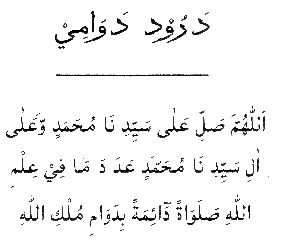
DUROOD-E-DAWAAMI


ALLAHUMMA SALLI ALA SAYYIDINA MUHAMMADIW WA ALA AALI SAYYIDINA MUHAMMADIN ADADA MA FI ILMIL LAAHI SALAWAATAN DAA’IMATAN BIDAWAAMI MULKILLAH.

“O Allah! Shower blessings on Muhammad, our master, in the number that is in Thy knowledge such blessings as may continue for ever eternal as Thy Kingdom”.

This Durood Shareef is of a very great value. If it is recited only once, it amounts to all the rewards of all the Duroods. By reciting this Durood, one gets peace of mind and success in this world as well as in the next. After reciting this Durood Shareef, the reciter can claim that he has recited almost all the Duroods which are in this world known to the people. During days of upheavals, this Durood Shareef brings relief, success and true happiness. It is mostly the Saints and very pious people who recite this Durood after every prayer. They also recommended this Durood Shareef to all the needy.

DUROOD-E-TUNAJJINA


ALLAHUMMA SALLI ALA SAYYIDINA WA MAULANA MUHAMMADIW WA ALA AALI SAYYIDINA WA MAULANA MUHAMMADIN SALAATAN TUNAJJINA BIHA MIN JAMI’IL AHWAALI WAL’AFAATI WA TAQDILANA BIHA MIN JAMI’IL HAAJAATI WATU TAHIRUNA BIHA MIN JAMI’IS SAYYI AATI WATAR FA’UNA BI HAA A’LAD DARAJAATI WATU BAL LIGHUNA BIHA AQSAL GHAAYAATI MIN JAMI’IL KHAIRAATI FIL HAYAATI WABA’DAL MAMAATI INNAKA ALA KULLI SHAY IN QADEER.

“O Allah! Shower blessings on Muhammad, our Master, and his Family such blessings by means of which Thou may relieve us of all anxieties and calamities. Thou may satisfy all our needs. Thou may clean us of all evils and thanks for which Thou may grant us high position and high rank and status in Thy presence, and Thou may lead us to the utmost limit of our aspirations and capacity in whatever is best in this world as well as in the world Hereafter, as Thou has the full Power over everything”.

This Durood Shareef is always a cure for all calamities in the world of worldly affairs. It was taught by Sayyiduna Rasoolullah (sallal laahu alaihi wasallam) himself. To recite this Durood Shareef 70 times during days of calamity, turmoil and trouble, is a must. It works wonders.

The great Scholar, Saint, Jurist and author, Imam ibn-Faikihani (radi Allahu anhu) says that there was once a pious man called Sheikh Moosa Zareer (radi Allahu anhu). He embarked on a voyage by ship. Due to a heavy storm, the ship started sinking. All the passengers on board started crying and clamouring, but Sheikh Moosa Zareer (radi Allahu anhu) went to sleep. He saw the Holy Prophet (sallal laahu alaihi wasallam) in his dream and the Prophet (sallal laahu alaihi wasallam) directed him and the passengers to recite Durood-e-Tunajjina 1 000 times. Sheikh Moosa Zareer (radi Allahu anhu) got up and started the recitation. As soon as he finished 300 Durood Shareefs, the storm subsided and the ship was saved. The other ship on the high seas sank, but this ship reached its destination safely and soundly. This miracle was a sufficient eye-opener for the members of the ship. It was by the Grace of Allah Ta’ala and Durood-e-Tunajjina that all were saved.

All the Saints have unanimously given verdict that Durood-e-Tunajjina is the best cure of all ills and all calamities of this world.

Wednesday, September 16, 2009

DUROOD-E-QURAANI

ALLAHUMMA SALLI WASALLIM ALA SAYYIDINA MUHAMMADIW WA ALA AALI WA ASHABI BI ADADA MA FI JAMI’IL QURAANI HARFAN HARFAN WABI ADADI KULLI HARFIN ALFAN ALFAN.

“O Allah! Send your blessings and peace on Muhammad, our Master, and on his Progeny and his Companions according to the number of every letter in Quran and let each letter carry thousands of blessings and salutations in it”.

This Durood Shareef is a very sacred one. If it is recited after every prayer, it is said that the reciter will receive the Sawaab equivalent to the recital of the entire Holy Quran. After reading the verses of the Holy Quran, this Durood Shareef should be recited 3 times.

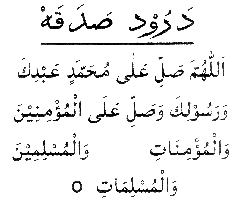
DUROOD-E-SADAQAH

ALLAHUMMA SALLI ALA MUHAMMADIN ABDIKA WA RASOOLIKA WA SALLI ALAL MU’MINEENA WAL MU’MINAATI WAL MUSLIMEENA WAL MUSLIMAATI.

“O Allah! Shower Thy blessings and beneficence on Muhammad, Thy creature and Thy Messenger, and shower beneficence on all men of faith and women of faith, and Muslim men and Muslim women”.

This Durood Shareef is a special one. Hadrat Abu Saeed Khudri (radi Allahu anhu), a close companion of the Holy Prophet (sallal laahu alaihi wasallam), says that Sayyiduna Rasoolullah (sallal laahu alaihi wasallam) said: “Whoever does not possess wealth to give in charity, should recite this Durood in his Du’a. It will become a source of (spiritual) cleanliness for him”.Hadrat Abu Huraira (radi Allahu anhu) says that the Holy Prophet (sallal laahu alaihi wasallam) said: “Allah has said, ‘If you spend I shall spend on you’”. This means that if you spend your money on others – the poor, sick, needy and the orphan – Allah will give you in abundance. But, what if a man has nothing to give in charity? By reading Durood-e-Sadaqah, it will suffice.

DUROOD-E-WALI


ALLAHUMMA SALLI ALA MUHAMMADININ NABI YIL UMMI YI WA AALIHI WABAARIK WA SALLIM.

“O Allah! Send blessings on Muhammad, our chief the unlettered Apostle and his Family Thy favours and thy Salutations”.

Hadrat Shah Wali’ullah Dehlvi (radi Allahu anhu) said that his father commanded him to recite the above Durood Shareef as it was the best one.

Hadrat Abu Hurairah (radi Allahu anhu), a close companion of Sayyiduna Rasoolullah (sallal laahu alaihi wasallam), has said that if a person recites this Durood eighty times on Friday (after evening prayers), then his sins equivalent to 80 years will be forgiven.

This is a very important Durood Shareef which brings forth immediate success and satisfaction to the heart and the mind.

Hadrat Zarar bin Auzar (radi Allahu anhu), another companion of the Holy Prophet (sallal laahu alaihi wasallam) says that he used to recite this Durood Shareef and fight with the non-believers. In every battle, he saw that success kissed his feet, and he never lost any battle on any day.

DUROOD-E-ALI

ALLHUMMAJ AL SALAWAATIKA WA BARAKAATIKA ALA MUHAMMADININ NABI YI WA AZWAAJIHI UMMAHAATIL MU’MINEENA WAZURRIYATIHI WA AHLI BAYTIHI KAMA SALLAYTA ALA IBRAHIMA INNAKA HAMEEDUM MAJEED.

“O Allah! Bestow blessing and bounty on our Prophet and on his wives, who are the Mothers of the Faithful, and on his descendants and on the members of his Household in the manner as Thou conferred blessings on Prophet Ibrahim. Verily, thou art the Praiseworthy and the Glorious”.

Hadrat Ali (radi Allahu anhu) said that if any one wishes that he should get the maximum reward for one Durood alone, then he must recite the above Durood Shareef.

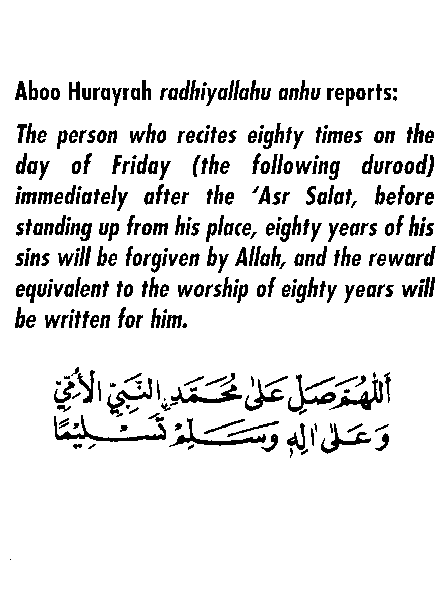
Salawat/Durood Nariya

Durood 80 times on Friday after Asr


Allahumma Salle 'Alaa
Muhammadinin Nabiyyi
l Ummiyyi wa-'Alaa
Aalehi wa-sallim
Tasleeyma.


Translation
:-
O Allah, bestow your blessings upon the unlettered Prophet and upon his family; and bestow your Mercy upon him and his family

Durood Shareef


Durood is a sure means of Allah Ta'ala granting blessings, peace, prosperity and favours of great magnitude on one who recites Durood Shareef on the Holy Prophet (Sallal Laahu Alaihi Wasallim). The reciter of Durood Shareef receives all the benefits in this world and utmost gain in the next world with addition to the love of the Holy Prophet (Sallal Laahu Alaihi Wasallim).


So All Muslims read Durood Shareef as much as you can. Allah will surely bless us all because He is the greatest.

durood

Monday, September 14, 2009

Different Du'as in Flash

Just like to share a Flash Presentation with Ramadan Du'as, Kalimas, Ayatul Kursi & many more with AUDIO.

Click any of these links to view the Flash Presentation:

www.4creativeweb.com/ramadan/ramadan.html
----------------------- or -----------------------
www.4creativeweb.com/ramadan/ramadanwith-audio.html (same presentation with Audio)

You can also download this Presentation as "exe" file from any of these links:

ramadan.exe (File size: 1.80MB)
http://www.zshare.net/download/ramadan-exe.html
----------------------- or -----------------------
ramadanwith-audio.exe (File size: 6.43MB, same presentation with Audio)
http://www.zshare.net/download/ramadanwith-audio-exe.html

May Allah reward whoever spreads this...

Best Regards
J.Syed Ali
www.4creativeweb.com
www.geocities.com/jsyedali99

Five Poisons of the Heart

1. Unnecessary Talking


Umar Ibn al-Khattab, may Allah be pleased with him, said: "A person who talks too much is a person who often makes mistakes, and someone who often makes mistakes, often has wrong actions. The Fire has a priority over such a frequent sinner."

2. Unrestrained Glances


It has been related that the Prophet once said words to the effect: "The glance is a poisoned arrow of shaytan. Whoever lowers his gaze for Allah, He will bestow upon him a refreshing sweetness which he will find in his heart on the day that he meets Him."

3. Too Much Food


Al-Miqdam ibn Ma'd Yakrib said: "I heard the Messenger of Allah say: "The son of Adam fills no vessel more displeasing to Allah than his stomach. A few morsels should be enough for him to preserve his strength. If he must fill it, then he should allow a third for his food, a third for his drink and leave a third empty for easy
breathing."

4. Keeping Bad Company


Allah's Apostle said , "The example of a good companion (who sits with you) in comparison with a bad one, is I like that of the musk seller and the blacksmith's bellows (or furnace); from the first you would either buy musk or enjoy its good smell while the bellows would either burn your clothes or your house, or you get a bad nasty smell thereof."


5. Excessive Sleeping


It is necessary for a person to have a sound sleep for good health and mind. But excessive sleeping causes an adverse impact on person. It has dire consequences on person’s RIZQ and BARAKAH. Therefore there is Hadith advising Duas asking refuge from lazy and dull heart and mind.

Hajj Vedio

Hajj Video: You can download Hajj Video from here. Just click on the download button (It will take hours for the video to be downloaded). After the download is complete simply click on the file as you click any excel or word file.
http://www.noorallahproductions.com/journey_of_hajj.htm

Islam and Relations


In the Name of Allah, Most Gracious, Most Merciful.

Cutting off Relations with Relatives is a Major Sin

(Friday speech delivered by Imam Mohamed Baianonie at the Islamic Center of Raleigh, NC on November 28, 1997)

Last Friday we learned about a number of major sins that we should avoid, and if we already fell in one or more of these major sins, we should repent with sincerity now and ask Allah (S.W.T.), the all-forgiving, all-merciful for forgiveness.

Today, I will talk about one of the major sins which is spread widely among Muslims today and which has lasted so very long till it became one of the habits which people do not realize and object it; that is cutting of the relations with relatives. This is a major sin with the consensus of all scholars because its prohibition and its warning are very emphatic, that is barring from entering Paradise on the Day of Judgment. This is clear from the hadith of the prophet (S.A.W.), which is reported by Imams Bukhari and Muslim, "One will not enter paradise if he/she cuts off relations with relatives."

Which relatives whom it is not allowed to cut off relations with?

They are the relatives whom you have the kith and kin relations with, whether they are the immediate relatives like the parents, brothers, sisters, uncles from the mother and the father sides, or the non-immediate relatives like cousins. This applies to both a Muslim or non-Muslim relative.

How is cutting off relations with them prohibited?

Cutting off relations with relatives is of various degrees of severity; the worst kind is to cut off relations with them completely (not even greetings or a single word with them). And a less severe degree is when you have less complete relations with them, the kind of relations where greetings are exchanged but there are no mutual visits on the appropriate occasions like Eid, weddings, and no support like financial support and no mutual help to stay well guided. All this is haram (prohibited), but some are worse than others.

What is mentioned in this subject?

Allah (S.W.T.) says in Surah Mohammed, (Verse 22 & 23), what can be translated as, "Would you then, if you were given the authority,

Do mischief in the land, and cut off your ties of kinship." Imam Ibn Katheer says, in his explanations of these two verses, "these verses mean that you go back to the period of ignorance (period before Islam); you spread mischief and transgress on earth, and cut relations off with relatives.... This is an emphatic, general prohibition from transgressing on earth and a special, emphatic prohibition from cuttings off relations with relatives.

Imams Bukhari and Muslim reported that the prophet (S.A.W.) said: "Allah created His creation, and when He finished it, the womb got up and caught hold of Allah whereupon Allah said, "What is the matter?" On that, it said, "I seek refuge with you from Al-Qati’ah (those who cut the ties of kith and kin)." On that Allah said, "Will you accept (be satisfied) if I bestow My Favors on him who keeps your ties, and withld My Favors from him who cuts your ties?" On that it said, "Yes, O my Lord!" Then Allah said, "That is for you." Then the Prophet Muhammad (S.A.W.), said recite if you wish "(The two verses 21 and 23 in surat Muhammad)"

In a Qudsi hadith reported by Imams Ahmad, Abu Dawud and At-Tirmithi, "Allah, the exalted, says: I am the Most Merciful, I created Ar-rahim and I cut out a name for it from my name, so whoever keeps good ties with it, I will keep good ties with him, and whoever cuts it off, I will cut him and finish him off."

The prophet (S.A.W.) also said reported by Imams Ahmad, Abu Dawud, At-Tirmithi, and Ibn Majah, "There is no sin that Allah (S.W.T.) more readily inflicts the punishment for in this life, in addition to what Allah (S.W.T.) keeps as punishment for the sinner in the Hereafter, than the sin of transgression and cutting off relations with relatives."

What do you do if you have relatives with whom you keep good relations, but they cut off all relations with you? Would you cut them of?

No, listen to the hadith of the prophet (S.A.W.) that was reported by Imams Ahmad and (Muslim in similar words.) when a man came to him and said, O messenger of Allah, I have relatives with whom I keep good relations, but they cut off relations with me, I forgive them, but they

oppress me, I do good to them, but they treat me badly, should I get even with them (treat them as bad as they treat me)? The prophet replied: "No, If you do so all the relations will be cut off this way. On the contrary, be generous and keep in touch with them, you will always have support from Allah as long as you stay this way."

Allah (S.W.T.) commands us to have good relations with our relatives, so He said in surat Ar-Ra’d, (Verse 21), what can be translated as, "Those who join that which Allah has commanded to be joined (i.e. they are good to their relatives and do not cut the bond of kinship)," and also mentioned to us that this is from the duties of a Muslim toward his relatives and also He (S.W.T.) said in surat Al-Isra’, (Verse 26), what can be translated as, "And give to the kindred his due…"

Imams Bukhari and Muslim reported that the prophet (S.A.W.) said, "Whoever likes that his sustenance becomes abundant and his age be longer, let him keep good relations with his relatives." Which means Allah (S.W.T.) will bless them.

Imams Bukhari and Muslim also reported that a Bedouin asked the prophet (S.A.W.), " O messenger of Allah tell me something that gets me closer to Paradise and gets me further away from Hell Fire. The prophet (S.A.W.) said, "Submit to Allah only and do not take partners with Him, establish prayers, and pay zakah, and establish good relations with your relatives." When the Bedouin left, the prophet (S.A.W.) said, "If he holds onto what I told him, he will enter Paradise."

Imams Bukhari and Muslim also reported that the prophet (S.A.W.) said, "Al-rahim is hung to the throne of Allah (Al-A’rsh) saying: Whoever connects me, Allah will connect him, and whoever cuts me off, Allah will cut him off."

After we heard all these verses, and many ahadith, we ought to take a serious look into our lives; if we find ourselves in this major sin of cutting off relations with our relatives, then we should repent sincerely. This repentance should stop us from falling into this sin, and regret for what we have done, and be determined not to fall in this sin again. We should repent now without delay, before it is too late because we do not know when death will come.

Sahih Al Bukhari - Urdu Tarjuma

1.
صحیح بخاری شریف [جلد اول].pdfصحیح بخاری شریف [جلد اول]
45.5 MB
صحیح بخاری شریف [جلد اول].pdfمواد کو ڈاون لوڈ کریں: صحیح بخاری شریف [جلد اول].pdfکھولیں: صحیح بخاری شریف [جلد اول].pdf
2.
صحیح بخاری شریف [دوسری جلد].pdfصحیح بخاری شریف [دوسری جلد]
41 MB
صحیح بخاری شریف [دوسری جلد].pdfمواد کو ڈاون لوڈ کریں: صحیح بخاری شریف [دوسری جلد].pdfکھولیں: صحیح بخاری شریف [دوسری جلد].pdf
3.
صحیح بخاری شریف [تیسری جلد].pdfصحیح بخاری شریف [تیسری جلد]
39.8 MB
صحیح بخاری شریف [تیسری جلد].pdfمواد کو ڈاون لوڈ کریں: صحیح بخاری شریف [تیسری جلد].pdfکھولیں: صحیح بخاری شریف [تیسری جلد].pdf
4.
صحیح بخاری شریف [چوتھی جلد].pdfصحیح بخاری شریف [چوتھی جلد]
44.5 MB
صحیح بخاری شریف [چوتھی جلد].pdfمواد کو ڈاون لوڈ کریں: صحیح بخاری شریف [چوتھی جلد].pdfکھولیں: صحیح بخاری شریف [چوتھی جلد].pdf
5.
صحیح بخاری شریف [پانچویں جلد].pdfصحیح بخاری شریف [پانچویں جلد]
39 MB
صحیح بخاری شریف [پانچویں جلد].pdfمواد کو ڈاون لوڈ کریں: صحیح بخاری شریف [پانچویں جلد].pdfکھولیں: صحیح بخاری شریف [پانچویں جلد].pdf
6.
صحیح بخاری شریف [چہٹی جلد].pdfصحیح بخاری شریف [چہٹی جلد]
38.7 MB
صحیح بخاری شریف [چہٹی جلد].pdfمواد کو ڈاون لوڈ کریں: صحیح بخاری شریف [چہٹی جلد].pdfکھولیں: صحیح بخاری شریف [چہٹی جلد].pdf
7.
صحیح بخاری شریف [ساتویں جلد].pdfصحیح بخاری شریف [ساتویں جلد]
40 MB
صحیح بخاری شریف [ساتویں جلد].pdfمواد کو ڈاون لوڈ کریں: صحیح بخاری شریف [ساتویں جلد].pdfکھولیں: صحیح بخاری شریف [ساتویں جلد].pdf
8.
صحیح بخاری شریف [آٹھویں جلد].pdfصحیح بخاری شریف [آٹھویں جلد]
36.5 MB
صحیح بخاری شریف [آٹھویں جلد].pdfمواد کو ڈاون لوڈ کریں: صحیح بخاری شریف [آٹھویں جلد].pdfکھولیں: صحیح بخاری شریف [آٹھویں جلد].pdf

72 SIGNS OF QIYAMAH IN THE LIGHT OF HADITHS

  • Alcohol will be called Sherbat and will be considered Halal.
  • a: Interest will be called Trade and will be considered Halal.
  • b: Bribes will be called Gifts and will be considered Halal.
  • c: Women will be naked in spite of wearing dresses.
  • People will usurp Ama'naat.
  • Lying will become an art.
  • There will be murders on the slightest of disagreements.
  • Interest will become common.
  • There will be very tall buildings.
  • People will sell religion for the world.
  • People will treat relatives badly.
  • Justice will become a rarity.
  • Lies will be considered truth.
  • Clothes will be of silk.
  • Persecution will become common.
  • Divorces will become common.
  • Sudden deaths will increase.
  • The usurper of Ama'naat will be considered honest and honorable.
  • The keeper of Ama'naat will be called an usurper of things given to him for safekeeping.
  • Liars will be thought of as honest.
  • Honest people will be thought of as liars.
  • False accusations will become the norm.
  • It will be hot in spite of rain.
  • Instead of wishing for children, people will pray that they not have children.
  • People from bad backgrounds and with bad upbringing will live a life ofluxury (material, not peaceful).
  • Good people, when they try to practice, will be cut off from the world.
  • Previously good people will also usurp Ama'naat.
  • Leaders will become persecutors.
  • Ulema and Qaris will commit adultery.
  • People will wear clothes of animal skin.
  • But their hearts will smell and will be dead.
  • And will be bitter.
  • Gold will become common.
  • Demand for silver will increase.
  • Sin will increase.
  • Peace will become rare.
  • Ayaats from the Quran will be decorated and calligraphy will become.
  • Mosques will be decorated.
  • And will have tall Minars.
  • But hearts will be empty.
  • Alcoholic drinks will be consumed.
  • Punishments ordered by the Shariah will be revoked and will not longer be implemented.
  • Women will order their mother around.
  • People who are with naked feet, naked bodies and against religion will become kings.
  • Women will trade along with men.
  • Women will imitate men.
  • Men will imitate women.
  • People will swear by things other than Allah and the Quran.
  • Even Muslims will be prepared to give false testimony, without being incited to it.
  • Only people one knows will be greeted with the salaam.
  • The knowledge of the Shariah will be used to earn worldly things.
  • Acts, which earn the Akhirah, will be used to earn the world.
  • Assets belonging to the nation will be considered and treated as personal treasures by the rulers.
  • Ama'naat will be considered ones personal asset.
  • Zakaat will be considered as a penalty.
  • The lowest and the worst man in the nation will become its leader.
  • People will not obey their fathers.
  • And will mistreat their mothers.
  • And will not hold back from harming their friends.
  • And will obey their wives.
  • And the voices of the men who commit adultery will be raised in mosques.
  • Women who sing will be treated with great deference.
  • Instruments of music will be kept with great care.
  • Alcohol will be drunk on the highways.
  • People will be proud of their acts of persecution.
  • Justice will be sold in the courts.
  • The number of men in the police force will increase.
  • Instead of music, the Quran will be used to gain pleasure for its tune and style (qirat), not for what it preaches, its meaning or for rewards in the Akhirah.
  • Animal fur will be used.
  • The last of the Ummat will curse those before them (clearly seen today in people who call the Prophet's companion's names).
  • Either Allah will send a Red Storm upon you.
  • Or Earthquakes.
  • Or your faces will be changed.
  • Or a rain of rocks from the skies. Asteroids? Meteors.
  • Lies will become a habit of the rulers and the rich

Sadaqat-ul-Jariyah

  • Give A Copy Qur'an To Someone And Each Time They Read From It, You Will
    Gain Hasanaat.
  • Donate A Wheel Chair To A Hospital And Time A Sick Person Uses It, You Will Gain Hasanaat.
  • Share constructive Reading Material With Someone.
  • Help In Educating A Child.
  • Teach Someone To Recite A Dua. With Each Recitation, You Will Gain Hasanaat.
  • Share A Dua Or Qur'an CD.
  • Participate In The Building of A Masjid
  • Place A Water Cooler In A Public Place.
  • Plant A Tree. Each Time Any Person Or An Animal Sits Under Its Shade Or Eats From the Tree, You Will Gain Hasanaat.
  • Share This articlel With Someone. If One Person Applies Any Of The Above You Will Receive Your Hasanaat Until The Day Of Judgment Incha Allah.Ameen

Read Quran at your desktop

An interesting work- read Quran at your desktop

Now read the Quran at your desktop. Arabic & english version, turn the pages of the quran by hand and read by yourself. Very interesting. 'The Quran Flash'. http://www.quranflash.com/en/quranflash.html
Jazaak Allah O Khair

The Pwer Of Dua

The dua can change our life, our outlook, and our fate. It is the most potent weapon of a believer.

What a tragedy, for dua is the most potent weapon of a believer. It can change fate, while no action of ours ever can. It is the essence of ibadah or worship. With it we can never fail; without it we can never succeed. In the proper scheme of things, dua should be the first and the last resort of the believer, with all his plans and actions coming in between.

Dua is conversation with Allah, out Creator, our Lord and Master, the All Knowing, the All Powerful. This act in itself is of extraordinary significance. It is the most uplifting, liberating, empowering, and transforming conversation a person can ever have. We turn to Him because we know that He alone can lift our sufferings and solve our problems. We feel relieved after describing our difficulties to our Creator. We feel empowered after having communicated with the All Mighty. We sense His mercy all around us after talking to the Most Merciful. We get a new commitment to follow His path for that is the only path for success. We feel blessed with each such commitment

In every difficulty our first action is dua, as is our last. We ask Allah to show us the way to handle that difficulty; we seek His help in following the path He shows to us; we seek His aid in making our efforts successful. When we fall sick, we know that we cannot find the right doctor without His Will; that the best doctor may not be able to diagnose our condition without His Command; that the best treatment plan will not succeed without His Permission. We make dua for all of these. We make dua before we seek medical help, while we are receiving it and after it has been delivered. The same is true of all other difficulties we may encounter.

Dua is the essence of ibadah. A person engaged in dua affirms his belief in Tawheed (monotheism) and shuns belief in all false gods. With each dua his belief in Allah grows. He beseeches Him, affirming his own powerlessness. A person seriously and sincerely engaged in dua understands exactly the relationship between himself and the Creator and affirms it through his actions. That is the essence of worship! Additionally, such a person can never become arrogant or proud, a logical result of true worship.

Dua is our most potent weapon in all struggles of life as well as in jihad in the battlefield. During the battle of Badr, the Prophet Muhammed(s.a. w) stood up all night in prayer seeking Allah's help in the battle between unequal armies that would follow the next day. In the decisive battles against the crusaders, Sultan Salatuddin Ayyubi was busy day and night. His days were devoted to Jihad. His nights were spent making dua, crying, seeking Allah's help. This has been the practice of all true mujahideen.

We should make it a point to make dua for all things big and small. It is the beginning of wisdom to realize that big and small are arbitrary labels that are totally irrelevant in this context. Nothing is too big for Whom we are asking from; nothing is too small for the one who is asking. That is why we have been taught to ask Allah when we need something as small as shoelaces. We should ask as a beggar, as a destitute person, for that is what we in reality are in relationship to Allah.

At the same time we should ask with great hope and conviction that we shall be granted our prayers. We should remember the Hadith: "There is nothing more dear to Allah than a servant making dua to Him." On the other hand, a prayer lacking concentration and conviction is no prayer at all.

We should make dua at all times, not only during times of distress. The Prophet Muhammad said: "Whosoever desires that Allah answers his duas in unfavorable and difficult conditions, he should make plentiful dua in days of ease and comfort." Also he said: "The person who does not ask from Allah, Allah becomes angry with him."

We should ask for all of our needs: those related to this world as well as those related to the Hereafter. Those who only concentrate on the former are, in effect, announcing that they don't care for their life in the permanent abode. They should blame no body but themselves for the total ruin in that world that Qur'an assures us awaits them. Those who only concentrate on the later are also showing lack of balance, for we need Allah's help to lead a good life here as well.

We should make dua not only for ourselves but also for our parents, brothers and sisters, spouses and children, relatives and friends, teachers and other benefactors, and destitute and struggling Muslims everywhere. We should pray for them for the good in this world as well as in the Hereafter. The Prophet(s.a. w) said: "The dua of a Muslim for his brother (in Islam) in his absence is readily accepted. An angel is appointed to his side. Whenever he makes a beneficial dua for his brother the appointed angel says, 'Aameen. And may you also be blessed with the same.'" [Sahih Muslim]

In the dark ages that we are living in today, everyday brings fresh news about atrocities committed against our brothers in Palestine, Kashmir, India, Afghanistan, Iraq, Chechnya, and the list goes on. And what do we do? We can continue to just feel frustrated and depressed.

We can petition the determined perpetrators or a fictional "International Community". We can just forget all this and move on to some other subject. Or we can stand up before Allah and pray for His help, who alone can help. The dua can change our life, our outlook, and our fate. It is the most potent weapon. But it works only for those who try sincerely and seriously to use it.

Features Of Zam-zam Water

1). This well has never dried up. On the contrary it has always fulfilled the demand for water.

2). It has always maintained the same salt composition and taste ever since it came into existence.
3). Its potability has always been universally recognised as pilgrims from all over the world visit Ka'aba every year for Hajj and umrah, but has never complained about it. Instead, they have always enjoyed the water that refreshes them.
4). Water tastes different at different places. Zam-zam water's appeal has always been universal.

5). This water has never been chemically treated or chlorinated as is the case with water pumped into the cities.
6). Biological growth and vegetation usually takes place in most wells. This makes the water unpalatable owing to the growth of algae causing taste and odor problems. But in the case of the Zam-zam water well, there wasn't any sign of biological growth.

7). Centuries ago, Bibi Hajra A.S. searched desperately for water in the hills of Safa and Marwa to give to her newly born son Hazrat Ismail A.S. As she ran from one place to another in search of water, her child rubbed his feet against the sand. A pool of water surfaced, and by the grace of Allah, shaped itself into a well which came to be called Zam-zam water.

ZAM ZAM Water

In 1971, an Egyptian doctor wrote to the European Press, a letter saying that Zam-zam water was not fit for drinking purposes. I immediately thought that this was just a form of prejudice against the Muslims and that since his statement was based on the assumption that since the Ka'aba was a shallow place (below sea level) and located in the center of the city of Makkah, the wastewater of the city collecting through the drains fell into well holding the water.

Fortunately, the news came to King Faisal's ears who got extremely angry and decided to disprove the Egyptian doctor's provocative statement. He immediately ordered the Ministry of Agriculture and Water Resources to investigate and send samples of Zam-zam water to European laboratories for testing the water. The ministry then instructed the Jeddah Power & Desalination Plant to carry out this task. I was employed as Desalting Engineer(Chemical Engineer) to produce drinking water from sea water). I was chosen to carry out this assignment. At this stage, I remember that I had no idea what the well holding the water looked like. I went to Makkah and reported to the authorities at the Ka'aba explaining my purpose of visit. They deputed a man to give me whatever help was required. When we reached the well, it was hard for me to believe that a pool of water, more like a small pond, about 18 by 14 feet, was the well that supplied millions of gallons of water every year to hajjis ever since it came into existence at the time of Hazrat Ibrahim A.S., many, many centuries ago. I started my investigations and took the dimensions of the well. I asked the man to show me the depth of the well. First he took a shower and descended into the water. Then he straightened his body. I saw that the water level came up to just above his shoulders. His height was around five feet, eight inches. He then started moving from one corner to the other in the well (standing all the while since he was not allowed to dip his head into the water) in search of any inlet or pipeline inside the well to see from where the water came in. However, the man reported that he could not find any inlet or pipeline inside the well. I thought of another idea.

The water could be withdrawn rapidly with the help of a big transfer pump which was installed at the well for the Zam-zam
water storage tanks. In this way, the water level would drop enabling us to locate the point of entry of the water. Surprisingly, nothing was observed during the pumping period, but I knew that this was the only method by which you could find the entrance of the water to the well. So I decided to repeat the process. But this time I instructed the man to stand still at one place and carefully observe any unusual thing happening inside the well.

After a while, he suddenly raised his hands and shouted, 'Alhamdollillah! I have found it". The sand is dancing beneath my feet as the water oozes out of the bed of the well.' Then he moved around the well during the pumping period and noticed the same phenomenon everywhere in the well. Actually the flow of water into the
well through the bed was equal at every point, thus keeping the level of the water steady.

After I finished my observations I took the samples of the water for European laboratories to test. Before I left the Ka'aba, I asked the authorities about the other wells around Makkah. I was told that these wells were mostly dry. When I
reached my office in Jeddah I reported my findings to my boss who listened with great interest but made a very irrational comment that the Zam-zam well could be internally connected to the Red Sea.

How was it possible when Makkah is about 75 kilometers away from the sea and the wells located before the city usually remains dry? The results of the water samples tested by the European laboratories and the one we analysed in our own laboratory were found to be almost identical.

The difference between Zam-zam water and other water (city water) was in the quantity of calcium and magnesium salts. The content of these was slightly higher in Zam-zam water. This may be why this water refreshes tired hajjis, but more significantly, the water contains fluorides that have an effective germicidal action. Moreover, the remarks of the European laboratories showed that the water was it for drinking.


Hence the statement made by the Egyptian doctor was proved false. When this was reported to King Faisal he was extremely pleased and ordered the contradiction of the report in the European Press. In a way, it was a blessing that this study was undertaken to show the chemical composition of the water. In fact, the more you explore, the more wonders surface and you find yourself believing implicitly in the miracles of this water that Allah bestowed as a gift on the faithful coming from far and wide to the desert land for pilgrimage.

25 Steps To Being Closer To Allah

  • Start off each day with 'adhkaar al-istiyqaadh' (waking up Supplications), thanking Allah for waking up in good shape.

  • Put Allah first in your life.

  • Broaden your horizons - learn 5 new verses from the Quran every day, travel to pray far in the mosque to brighten your day,take up a booklet having supplications and read them.

  • Pray Salaat Al-dhuhaa (after sunrise).

  • If someone says something mean ;to you, just shrug it off and dismiss it in a friendly, laidback manner, and pray that Allah shall forgive them.

  • When you get angry, remember Allah, and how short and worthless life is to waste in being Angry.

  • Remember that you can never have too many friends, but you can have few quality friends that help you fulfill the purpose of your creation (i.e. live for Allah).

  • When you're happy, try to share your happiness with others. Thank Allah for that, and pray its continuation.

  • When something bad or embarrassing happens to you, just think that it could always be worse, remember the reward of patience,and thank Allah that it's not worse than it is.

  • Do something extra of goodness once in a while, like feeding a poor person, or caressing an orphan's head.

  • Never stop believing that you can win Allah's love and thus work For it. Then you can win the love of Allah's slaves.

  • Spend some time thinking of Allah's amazing creation.

  • Always love those who love Allah unconditionally. This way you will ensure that you live for Him, love for Him, and hate for Him(those who are enemies of Him).

  • Find the righteous ways to express yourself, and if you think that what you are about to say shall cause no benefit, maintain silence (this is tough!!).

  • Every now and then, give yourself a break. Play sports, give time to your family, friends, but always remember Allah and watch that He is watching you.

  • Pray for blessing to come to those being lost, and pray to Allah to guide them to the right path.

  • Hug your parents, kiss their hands and heads and always obey but stop at Allah's orders.

  • Smile to everyone, for your smile makes a big difference to him or her and you are rewarded.

  • Forgive, forget and smile.

  • Tears are not for women only... tears are for all human beings with feelings remaining in them. Don't restrain your tears when remembering Allah.

  • When people criticize your actions and effort, revise your actions and see if they please Allah or no. If they do; then ignore and remember how the Prophet (SAAW) and the Sahaba were criticized, made fun of and even physically harmed, so have patience.

  • Read the Quran daily and try to have a schedule for completing it as much as you could. As you open the Quran daily, read with observing not just passing your eyes through the words.

  • Don't let popularity go to your head, for it never lasts and you may lose from it more than gain.

  • Never look down on anybody, for, to Allah, they may be better than you.

  • Send this to all brothers with the intention of having a healthy society living for Allah and pray.

SUTRA

Before a person starts to pray he should place something at a short distance in front of him on the place where he prostrates (does Sajdah). Such an object is called SUTRA and is used when the person is praying alone. A person passing in front of the person in prayer, should pass on the outside of the sutra.

If someone is praying in congregation, then the imam acts as the sutra. The imam, however, must have his own individual sutra in front of him.